 Wednesday, September 21, 2016, Berkeley, CA: Celebration of the paperback edition of The Village of Bones. Mary will read selections from The Village of Bones and sign books. There will be time to have fun, browse the books in one of the West Coast’s finest bookstores, and talk to interesting people. TIME: 5:30 to 7:00 pm. PLACE: University Press Books, 2430 Bancroft Way, Berkeley CA
Report from Berlin Furry Convention and Book Party Invitation
|
|||||||||||||||||||||||||||||||||||||||||||||||||
|
|||||||||||||||||||||||||||||||||||||||||||||||||
|
|||||||||||||||||||||||||||||||||||||||||||||||||
|


How to Archive Your Literary Papers
 A few months ago, I packed up six drafts of my recently published novel The Village of Bones and sent them to Smith College along with thirty-eight boxes of other materials that span my writing career. I have been saving these materials for well over forty years; and after fifteen years of inventive procrastination, I finally gotten around to archiving them. The result is that I now have a clean basement (who knew the floor was made of concrete?) and the Sophia Smith Special Collections Library in Northampton, Massachusetts has my Literary Papers.
What are “Literary Papers?” Well, “The Mary Mackey Papers,” as Smith calls them, include among other things: copies of all the foreign and English language editions of my novels and collections of poetry; multiple handwritten drafts of my works; copies of every magazine with my written work; fliers for most of the readings and lectures I’ve done; photographs of me from age two to the present; literary correspondence from famous writers like Yevgeny Yevtushenko and Marge Piercy, and less well known writers who should be better known; posters almost too big to mail, and chapbooks so small that if you gasped, you might inhale them.
Smith even asked me to send them my juvenilia, a term for the things I wrote when I was a child; so I have had the fun of finding my first novel (a science fiction piece written when I was nine about a little girl who outwits alien robots) and my first collection of poetry (handwritten on lined paper when I was eleven).
As you can see, “archiving” your literary papers means much more than simply placing copies of your books in a library. A university archive is like a safe or a time capsule. Smith is going to put every scrap of my materials in a specially constructed part of the Special Collections Library where they will be preserved in a climate-controlled environment and protected from insects and mold, not to mention floods, fires, mudslides, and earthquakes. Thus, The Mary Mackey Papers will be available to the general public, students, and scholars of the future for all eternity, or at least until climate change makes the human race extinct.
I want to encourage every woman writer reading this to think about archiving her literary papers. (Actually every male writer should too, but that’s another issue.) Please don’t think: “There’s no use my trying to find a place to archive my work. I’m not important enough. No one will want my papers.” Almost every woman I’ve told about the archiving process has said this, including famous poets and best-selling novelists. On the other hand, when I mention archiving to male writers they tend to say: “That’s a great idea. Of course my work should be preserved for posterity.” Or sometimes: “I don’t think anyone will want my papers, but I’ll give it a try. All they can do is say ‘no.’”
The men are right. If you contact an institution about archiving your papers, the worst they can say is: “No, we can’t take them.” But if you don’t try, your work may end up in a dumpster. You need to archive your papers now, while you are alive and can made all the important decisions. Don’t leave archiving your papers to your heirs or they may dump your old love letters in with the rest, and you may end up being known to future generations as “Snookums.”
So how do you go about archiving your papers? Well, that depends. If you are younger, you probably don’t have much. In fact, everything you have may be in digital form, so you need to begin printing some of it out. Not all of it, but a few drafts, important emails, etc. You should also start saving fliers from the readings you do. And don’t throw away those poems you wrote when you were nine. Keats kept his early poems. Keep yours.
If you are over fifty (or already very well-known), you need to make a general list of what you have and estimate how much room it takes up. Then you need to find out which libraries, universities, or museums already collect the kinds of things you have.
Next, you need to send a brief email to places you think might be interested in archiving your papers. Introduce yourself, describe the highlights of your collection and its significance, attach a very brief bio, and ask them if they are interested in seeing more. My initial email was three paragraphs, sent out with the subject line “Interested in a literary collection?”
Archiving your papers is particularly important right now. Literary correspondences are occurring in emails; drafts of novels and poems are being stored in the Cloud; news of readings are coming via MailChimp. According to the archivists I have spoken to, the life of digital material is about five years. Then bit rot sets in, and the files are no longer readable.
In other words, the entire literary life of the twenty-first century is being written on water. Let’s see that it’s written in stone.
If you do archive your papers, that is to say if you place them in a climate-controlled environment in a university or museum archive, I have a present for you: I have created A Guide To Women Writers’ Archives on my website. Send me your information, and I will put you up there with Mary Shelley, Margaret Atwood, Jane Austen, and Maya Angelou.

Mary Mackey is a bestselling author who has written seven volumes of poetry including Sugar Zone winner of the 2012 PEN Oakland Josephine Miles Award for Literary Excellence. She is also the author of fourteen novels some of which have appeared on The New York Times and San Francisco Chronicle Bestseller Lists. For more information about Mary’s books, including her recently published novel, The Village of Bones, please visit her website.
This article was originally posted on the Women’s National Book Association, San Francisco Chapter, website. To see it in its original context CLICK HERE.
MARY MACKEY’S “THE VILLAGE OF BONES” HAS JUST BEEN PUBLISHED

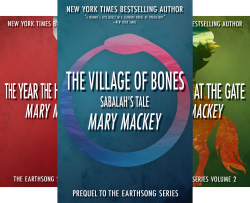
Lowenstein Associates has just published The Village of Bones, Sabalah’s Tale, the Prequel to my best-selling Earthsong Series. If you buy the novel before May 15th, you can get a FREE Kindle edition of The Year the Horses Came, which is the next novel in the Series.
“Mary Mackey’s The Village of Bones, gives us the vivid adventures of The Clan of the Cave Bear, the magic of The Mists of Avalon and Lord of the Rings, and the beauty of Avatar. Filled with the belief that love drives out fear, it contains stunning twists that will leave you wanting more.” –Dorothy Hearst, author of the Wolf Chronicles
A perilous journey, a stunning prophecy, a dangerous love that could destroy humankind: In 4386 B.C., a young priestess named Sabalah conceives a magical child with a mysterious stranger named Arash. Sabalah names the child Marrah. This child will save the Goddess-worshiping people of Europe from marauding nomad invaders called Beastmen, but only if her mother can keep her alive long enough to grow up. Warned by the Goddess in a vision of the coming invasion, Sabalah flees west with Arash to save her baby daughter, only to discover that she is running into the arms of her worst enemies. In the dark forests of northern Europe, other human-like species left over from the Ice Age still exist.
Click here to buy the Kindle e-book.
Click here to buy the paperback edition.
Click here for your FREE Kindle e-book edition of The Year The Horses Came.
Interview With A Witch
Mary Mackey Interviews San Francisco Witch Starhawk
 Mary: Welcome to People Who Make Books Happen, Starhawk. I’ve been wanting to talk to you for a long time about your work as a Witch, and am pleased to be able to help you celebrate the publication of your new novel City of Refuge.
A novel-writing Witch is not the kind of Witch you come across every day. In fact, people often have a stereotyped image of a Witch as an old woman in a pointed hat who flies around on a broomstick. What does it mean to call yourself a Witch in 2016? What does the title “Witch” mean to you and how does it differ from the stereotype?
Starhawk: For me, being a Witch means having a commitment to the ancient, earth-centered spiritual and healing traditions of Old Europe and the Middle East, and serving the well-being and development of the community that is practicing and regenerating this spiritual path. It is also a way of identifying with and reclaiming the heritage of the many, many women and men who have been persecuted down through the ages for holding to the old belief that the earth is sacred.
Mary: How did you become a Witch?
Starhawk: I first met Witches when I was researching an anthropology project in my Freshman year at UCLA back in 1968. I began studying with them—and when I became part of the second wave of the feminist movement in succeeding years, it seemed to that an ancient religious tradition with a focus on the Goddess, that offered roles of responsibility and leadership to women, was an important aspect of empowering women. When I moved to San Francisco in 1975, I began training with Victor Anderson of the Feri Tradition and was initiated—I went through a ritual of commitment and empowerment. In the early ‘80s, a group of us began what became the Reclaiming Tradition, bringing together deep magic, personal and collective healing, political action and practical earth healing.
Mary: Can you briefly tell us about the Wiccan Religion and Contemporary Paganism? For example, when did Wicca become an officially recognized religion in the United States?
Starhawk: The contemporary Pagan revival has many strands—the interest in occultism and Eastern spirituality going back to the 19th century in England and US, the writings and teaching of Gerald Gardner and his followers in England in the 50s, the interest in Eastern and indigenous spirituality in the ‘60s, and the feminist movement in the ‘70s and ‘80s where we began searching for alternatives to patriarchy.
The US doesn’t officially recognize religions—the body that does is simply the IRS, which awards the non-profit religious organization status. The Covenant of the Goddess received that status in 1975, and many other Wiccan and Pagan organizations have done so since, including various groups within Reclaming’s extended network. Many Wiccan and Pagan organizations have taken part in interfaith organizations—including the Parliament of The World’s Religions, and have also mounted successful campaigns to get Wicca recognized by the military. Ongoing campaigns include the efforts spearheaded by Patrick McCollum to get Wiccan and Pagan chaplains for prisoners in California and other states. Slowly, we are gathering more widespread recognition.
Mary: How has being a Witch influenced your life and your work?
Starhawk: My deepest spiritual experiences have always taken place in nature, and discovering that there was a spiritual tradition that honored nature as sacred, for me, was like coming home. Wicca teaches that the Goddess is immanent in the natural world and in human beings, and for me, this is the ground of my spiritual practice, my political work for social and environmental justice, and my creative work as a writer, film maker and permaculture teacher and designer.
 Mary: Your new novel City of Refuge is a sequel to your earlier novel The Fifth Sacred Thing which is often assigned in courses on Woman’s Spirituality. Could you please briefly describe both novels? What is the most important thing you want your readers to take away from City of Refuge?
Starhawk: Both The Fifth Sacred Thing and City of Refuge are set in the mid-twenty-first century, when, after environmental and social meltdowns, Northern California has become a matrifocal, multi-cultural, ecological balanced society, devoted to peace, art, and connection. Southern California has become the opposite—militarist, racist, with huge divides between rich and poor. When the Southlands invade the north, the people of Califia struggle with the question of how to defend themselves without becoming what they are fighting against.
 For me, The Fifth Sacred Thing came directly out of the research I had been doing on the period you yourself write about in your Earthsong Series novels about the Goddess-worshiping cultures of Neolithic Europe: the shift from the early matrifical cultures of the Goddess to patriarchal, warlike cultures. I was asking myself the question: Could it have been different? Could those peaceable early cultures have resisted the takeover without changing so drastically into something resembling the invaders? Or, even more crucial, could we do that now? Is it worth trying to develop a society rooted in peace and cooperation if it is doomed to be conquered?
City of Refuge begins where The Fifth Sacred Thing leaves off. The invaders have been ousted, and much of their army has defected and joined the Califians. The book centers around a different question: How can we build a new world when people are so deeply damaged by the old?
Mary: How, if at all, has your perspective on nature, society, and spirituality changed since you wrote The Fifth Sacred Thing in 1993?
Starhawk: I have a great deal more knowledge around practical earth healing, permaculture and ecological design, and much more experience in situations of intense conflict, such as the global justice mobilizations of the early part of this century, of supporting the nonviolent resistance in Palestine to the Occupation, of aiding relief efforts in New Orleans after Hurricane Katrina. I have a wider breadth of experience, and probably seen more nuances. For me, a novel centers around a question, not around answers, and I continue to hold these great questions. I don’t expect to find clear answers in my lifetime, but in wrestling with the questions, we may find a way forward.
Mary: Both The Fifth Sacred Thing and City of Refuge are post-apocalyptic novels. Do you think we are headed for a planetary apocalyptic melt-down?
Starhawk: There’s a proverb, reputed to be Native American, that says: “If we don’t change our direction, we’re going to wind up where we’re headed.” It doesn’t take a prophet to see where we’re headed toward destruction. We’re already past the tipping point on climate change. We’re experiencing a concentration of wealth and power and a militarization of everyday life on an unprecedented scale, and the two crises are really the same one—the ultimate end of a patriarchal war culture that places profit and weapons over caring and nurturing. But I also believe that we have the tools, insights, and technologies to turn it around, that we still have the potential to use the resources we still have now now to create the resources we need for a new world, one in balance with nature and where we prize interconnection over domination.
It’s a question of political will. I believe that making this transition is the biggest challenge we face in the coming years, and that all of us have come into life at this time to make our own unique contribution to the change.
Mary: What is the most important thing we can do to meet that challenge on both a personal and global level? Can we build a City of Refuge?
Starhawk: To meet that challenge, I encourage people to educate themselves, to become ecologically literate and socially adept, to learn about other cultures and explore multiple perspectives. I also encourage everyone to give yourself time to have your own connection to the natural world, to spend some time each day listening to nature and observing the plants, trees, animals, sky, water and soil. And then—take action. Ask yourself what you most deeply care about, and put yourself at its service. Organize, or join with others. Stand up against the destruction, but do it with an awareness of what we want to create. And don’t lose hope!
Mary: For many years you have taught classes in non-violence and earth-based spirituality. Could you briefly describe the classes you are currently offering and tell people how they can enroll?
Starhawk: I currently teach a lot of workshops, give many talks and discussions, and direct an organization called Earth Activist Training, where we teach permaculture—ecological design—with a grounding in spirit and a focus on organizing and activism. We also give courses in social permaculture—applying ecological and systems thinking to human relationships and group dynamics. People can find out more information on my website, starhawk.org, and on the Earth Activist Training site.
Mary: Will you be doing any public readings from City of Refuge this spring?
Starhawk: I’ll be doing lots of traveling, talks, and readings throughout this spring and next year as well. My full schedule can always be found at starhawk.org, and people can also sign onto my mailing list to get advance notice of events.
Mary: Thank you for taking the time to talk to us today.
Starhawk: It’s been a pleasure.
Starhawk is one of the most respected voices in modern earth-based spirituality. Besides being a practicing Witch, she is the author or co-author of twelve books, including The Spiral Dance: A Rebirth of the Ancient Religion of the Great Goddess, long considered the essential text for the Neo-Pagan movement, and the now-classic ecotopian novel The Fifth Sacred Thing, now in development for film and television. Her most recent novel City of Refuge is the long-awaited sequel to The Fifth Sacred Thing. Starhawk’s papers are archived at the Graduate Theological Union in Berkeley, California.
Join this People Who Make Books Happen conversation with Starhawk. You are warmly invited to leave a comment. People Who Make Books Happen is where the experts hang out.
For writing advice; a sneak peek at Mary’s new novel The Village of Bones; Mary’s latest news; course syllabi; resources for Women’s Studies, Women’s Visionary Fiction, Women’s Visionary Film, Women’s Visionary Poetry, and Advanced Composition and more information about writing and teaching, you are invited to visit my website homepage and click on the tabs.
My Literary Papers Are Going To Smith College
 After procrastinating for fifteen years, I finally vowed this summer to place my literary papers somewhere where they could be properly archived and preserved. My poems, novels, and manuscripts are going to be housed at the Sophia Smith Special Collections Library at Smith College in Northampton, MA. This means Smith is taking my first editions, manuscripts, rough drafts of my poems and novels, fliers for all the readings I’ve done, copies of all the publications that contain my work, and a lot of other things including my literary correspondence. This also means that if you have ever published one of my poems or written me a letter or an email that does not contain intimate personal information, your work will also be housed with the Mary Mackey Papers at Smith forever or until the human race goes extinct from climate change.
If you are a writer, an artist, editor, or publisher, or have records of a career that will be of interest to future scholars, I urge you not to follow my example and wait fifteen years to archive your papers. Please do it now while you are alive to make vital decisions about your collection (like removing all those old love letters). I talked to archivists from thirteen universities and special collections libraries this summer, and several of them told me that the life expectancy of digital material is about five years. If you aren’t old enough or far enough along in your career to archive your papers, please make hard copies of your material. The history of the twenty-first century is being written on water. Let’s write it on stone.
If you would like to sign up for my newsletter click here